

Quantum Model of the Universe: Four Monographs and Twelve Volumes of a New Research Architecture
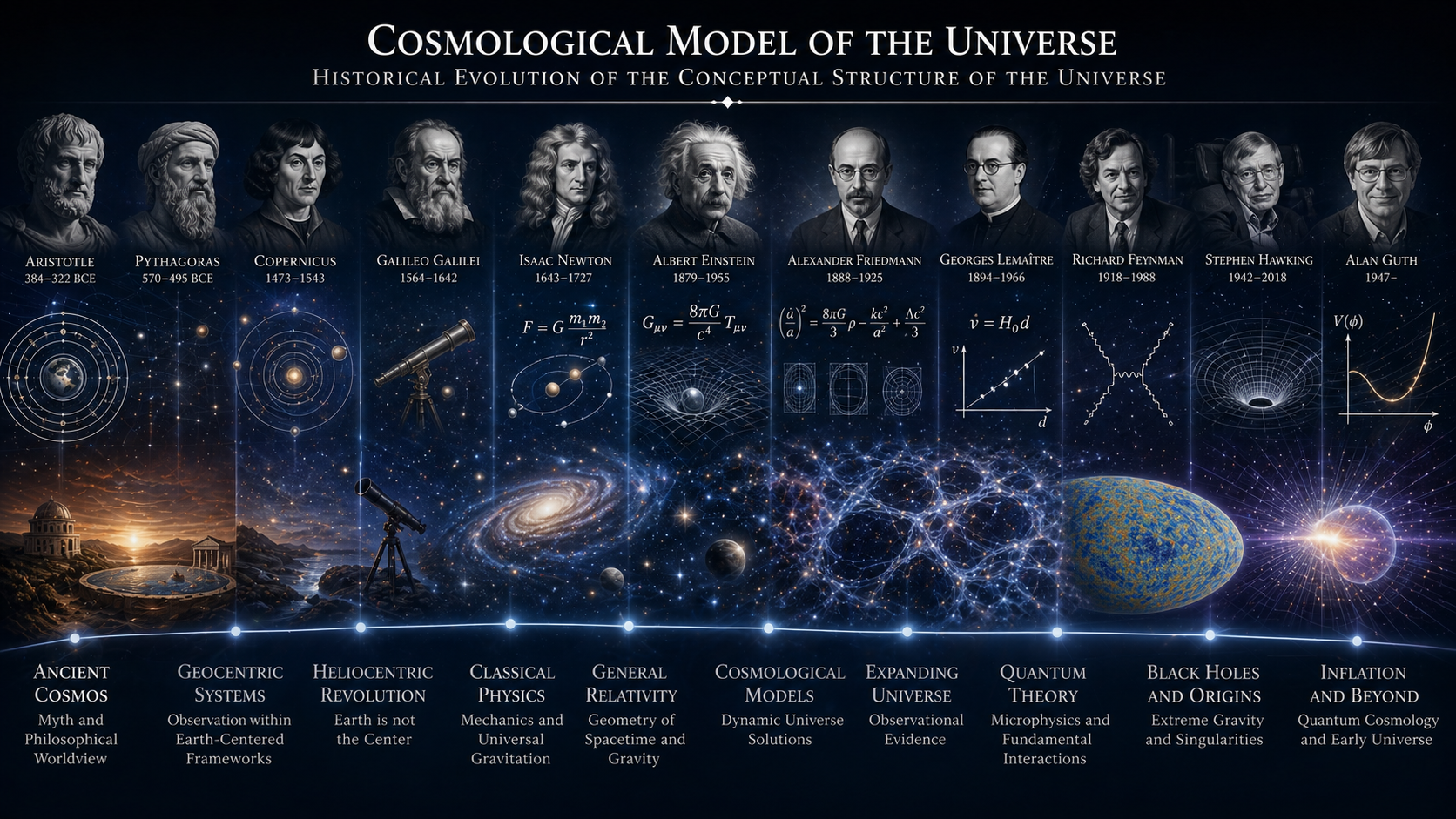
The Universe is not divided into the microworld and the macroworld. It is our description that turned out to be divided.
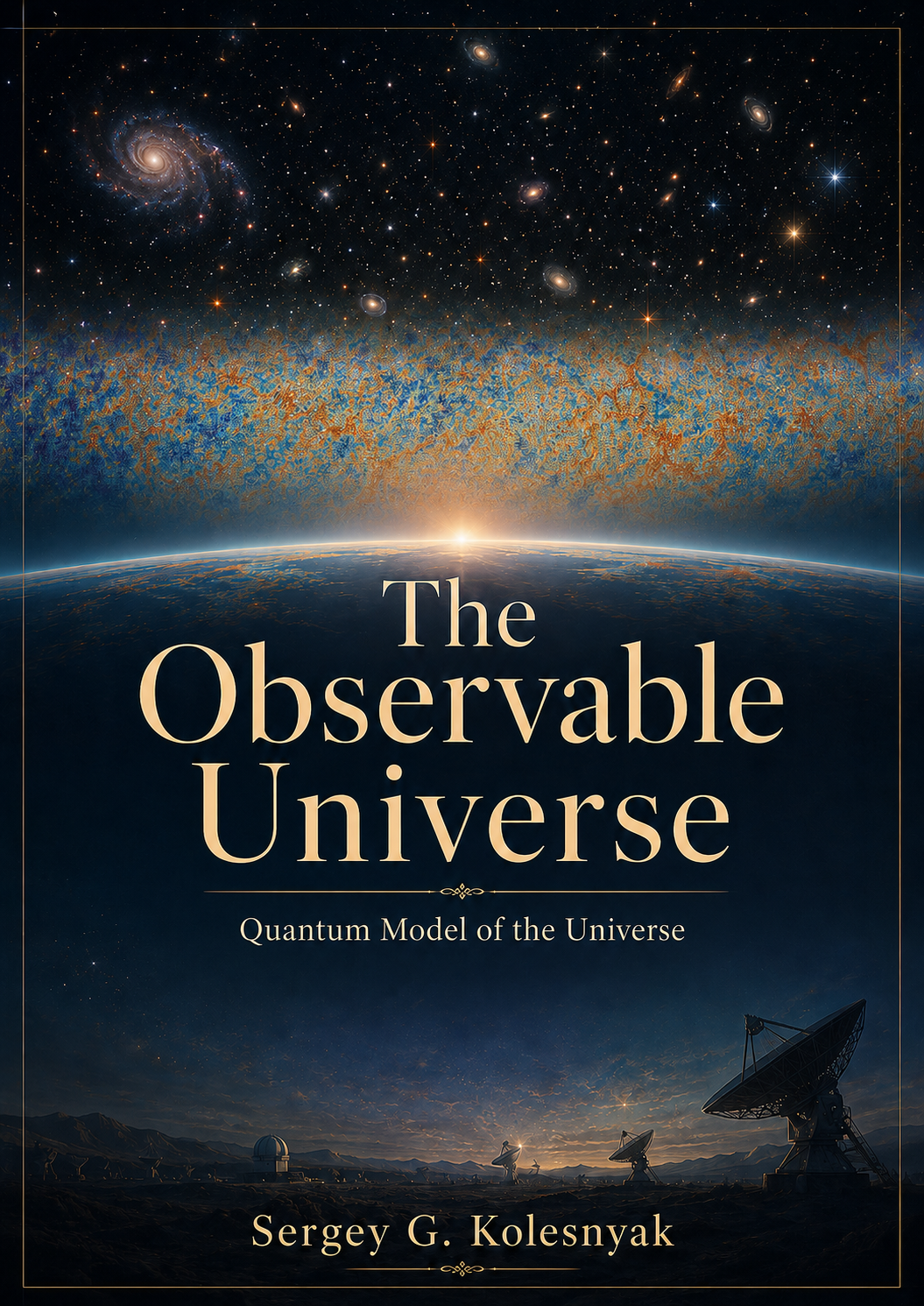
The first volume of the Quantum Model of the Universe builds a structural passport of the observable Universe: particles, fields, constants, vacuum states, galaxies, cosmic expansion, dark matter, and dark energy within one unified map.
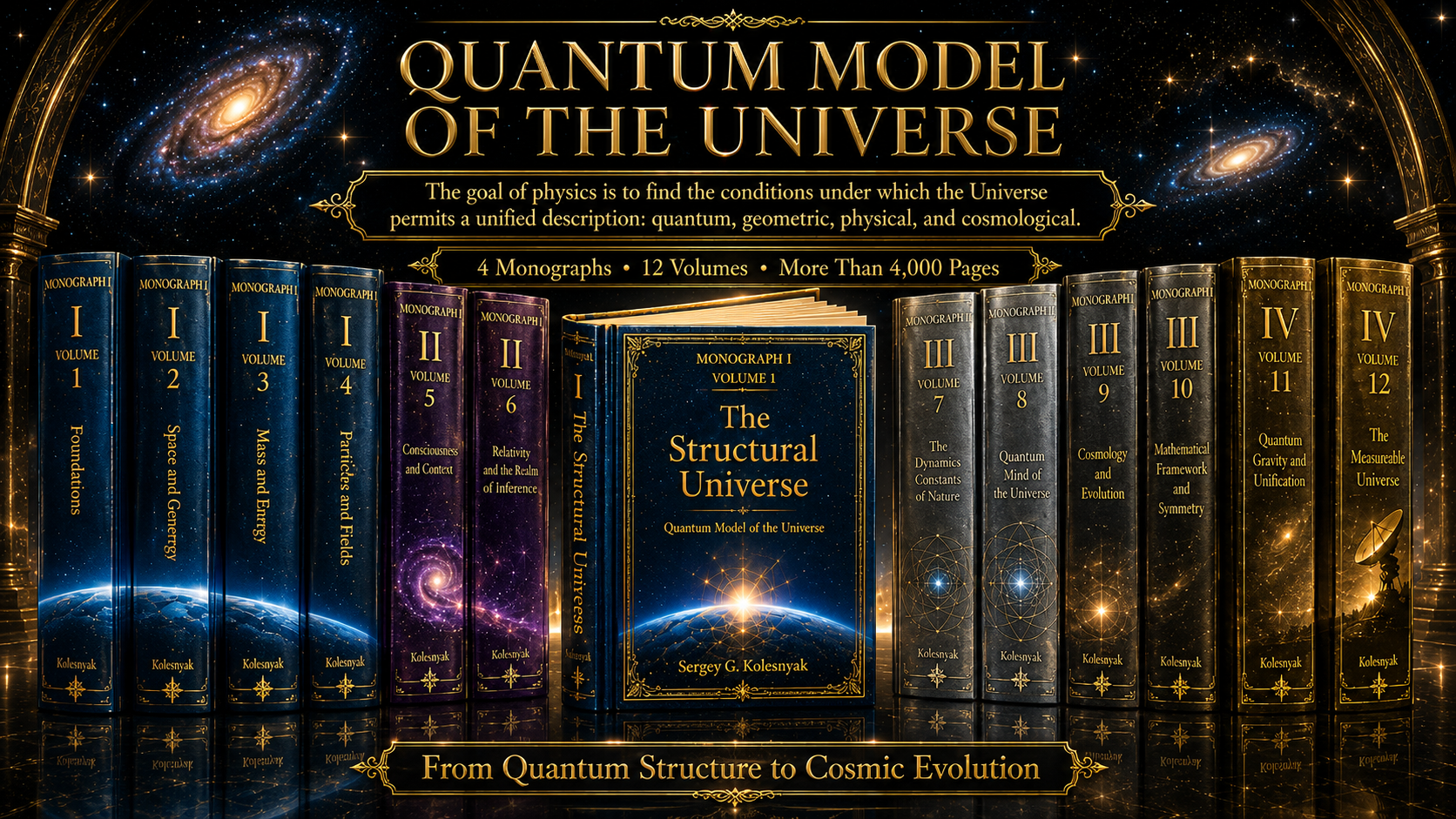
The goal of physics is to find the conditions under which the Universe permits a unified description: quantum, geometric, physical, and cosmological.
The goal of physics is to find the conditions under which the Universe permits a unified description: as a quantum, geometric, physical, and cosmological system
The project is organized as a sequential research system. The first forms the initial structural and empirical map. The second develops an architecture of admissible extensions of modern physics and cosmology. The third is devoted to fundamental constants, physical quantities, and their possible dynamic evolution. The fourth brings the analysis to geometry, information, simulation, and the structural limits of fundamental physics.
The Quantum Model of the Universe is not a rejection of classical physics, quantum theory, or modern cosmology. It is an attempt to see the Universe not as a collection of separate theories, but as a single structural system in which the microworld and the cosmos obey a common logic of evolution.
The first monograph consists of three volumes. Its first volume is titled The Structural Universe and serves as the entry map for the project. It examines the structure of the Quantum Model of the Universe, the logical map of the Universe, its structural core, known tensions in modern cosmology, and what may be called a “passport of the Universe”: a systematic description of the main known and observationally established parameters of the cosmological system.
This passport includes particles, fields, interactions, constants, vacuum states, microphysical and astrophysical regimes, black holes, galaxies, large-scale structure, the cosmic web, expansion parameters, dark matter, dark energy, cosmological time, and other key characteristics of the observable Universe. The project has also been nominated in the 2026 World Academy Awards cycle, further marking its emergence as a large-scale independent contribution to contemporary theoretical physics and cosmology.
It then moves from inventory to testing structural boundaries: collider results, the Higgs boson, unconfirmed supersymmetry and WIMP dark matter candidates, electroweak vacuum stability, matter-antimatter asymmetry, reductionism, microphysics and cosmology, JWST, DESI, the cosmic microwave background, gravitational lensing, dark sectors, accelerated expansion, evolving constants, and major scientific transitions.
“The Universe is not divided into the microworld and the macroworld. It is our description that turned out to be divided. The task of the Quantum Model of the Universe is to find a language in which the quantum level and the cosmological scale again become parts of one picture.”
The second monograph consists of four physical volumes. It is the structural-hypothetical part of the project, where physical domains are treated as admissibility problems: which extensions may be introduced, how they must be constrained, which standard limits they must recover, and when they must be rejected. The first volume introduces quantum, relativistic, and primordial cosmological admissibility. The second focuses on cosmic acceleration, vacuum dominance, horizons, entropy, backreaction, dynamic vacuum terms, and Friedmann recovery. The third turns to multi-domain cosmology, galaxy formation, and black-hole regulation. The fourth connects this architecture with observational interfaces, gravitational-wave and infrared-background channels, galaxy correlations, planetary and biochemical thresholds, information channels, and global consequences. A key rule is that if an operator, parameter, or hypothesis fails boundedness, observational separability, or standard recovery, the local construction must be withdrawn.
“The central question of modern physics is under what conditions a unified description of the Universe is possible — from vacuum and particles to galaxies and cosmic structure.”
The third monograph consists of two volumes and is devoted to fundamental constants, physical quantities, and their possible dynamic development in cosmic evolution. It examines the invariance of natural laws, the quantum vacuum as a physical medium, the possible dynamical status of constants, the cosmological constant, structural admissibility, ΛCDM, and systemic tensions. It treats α, G, ℏ, electric charge, particle masses, vacuum energy, time, dark matter, dark energy, and falsifiability not as isolated topics, but as elements of a vacuum-metric framework in which constants and cosmological parameters characterize the state of the Universe at different stages of its evolution.
“The Quantum Model of the Universe treats the evolution of the Universe as a single process in which vacuum, geometry, fundamental constants, matter, and large-scale structure are not isolated from one another, but are connected by a shared history of physical formation.”
The fourth monograph consists of three volumes and brings the project to geometry, information, simulation, and the structural limits of fundamental physics. One central volume, Geometry, Information, Simulation, and the Structural Limits of Fundamental Physics, treats the observable Universe as a measurable physical system while showing that empirical closure is not theoretical closure. It examines precision cosmology, initial conditions, quantum fluctuations, structure formation, the collider frontier, dark sectors, early galaxies, black holes, singularities, holography, quantum information, simulation, causal structure, infrared gravity, vacuum, theory space, and the limits of parametric description.
The Quantum Model of the Universe does not ask whether modern physics should be replaced. It asks how successful but incomplete theories can become parts of a single physical architecture. Modern cosmology, quantum theory, general relativity, particle physics, observational astronomy, and computational methods remain the scientific foundation. The project maps conditions under which they may be coordinated within a broader architecture, emphasizing admissibility, testability, standard recovery, and local rejection of hypotheses that fail empirical or mathematical constraints.
The author expresses sincere gratitude to readers, researchers, editors, consultants, and colleagues who write, ask questions, send comments, and support the project.
At this stage, the main practical task is publication of the prepared volumes by international publishers and their delivery to the scientific community, university libraries, research centers, and interested readers. One important publication stage is connected with River Publishers. Website: www.riverpublishers.com.
Orders after publication will be available through River Publishers and directly through the author. For publication inquiries, pre-orders, scientific contacts, and volume acquisition, please contact:
Sergey G. Kolesnyak
E-mail: intellectpictures@gmail.com
Serge Kolesnyak
World Academy Awards
+41 22 919 39 39
intellectpictures@gmail.com
Legal Disclaimer:
EIN Presswire provides this news content "as is" without warranty of any kind. We do not accept any responsibility or liability for the accuracy, content, images, videos, licenses, completeness, legality, or reliability of the information contained in this article. If you have any complaints or copyright issues related to this article, kindly contact the author above.
